


Last Updated on 26/12/2025 by Rasheed Busari
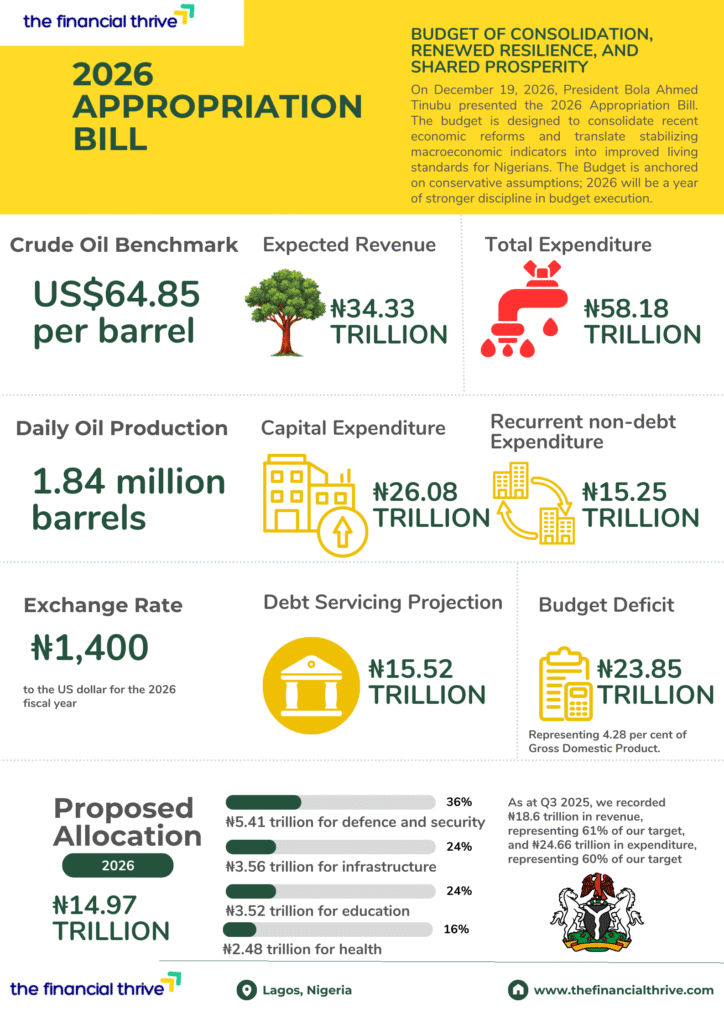
On December 19, 2026, President Bola Ahmed Tinubu presented the 2026 Appropriation Bill to the National Assembly. The theme—“Budget of Consolidation, Renewed Resilience, and Shared Prosperity”—captures the administration’s intent to move Nigeria from a state of reform turbulence to macroeconomic stability and improved welfare outcomes. He said the era of overlapping budgets, abandoned projects, inherited obligations, and perpetual rollovers must come to an end if Nigeria is to achieve fiscal discipline and sustainable development.
Unlike expansionary budgets of the past, the 2026 budget signals a fiscal consolidation phase, focused on discipline, realism, and execution rather than headline spending growth.
Strategic Objective of the 2026 Budget
The 2026 Budget is designed to consolidate recent economic reforms, including subsidy removal, foreign exchange market adjustments, and revenue mobilization initiatives. The goal is to convert stabilizing macroeconomic indicators into tangible improvements in living standards while strengthening fiscal sustainability.
Importantly, the budget is anchored on conservative assumptions, suggesting a deliberate attempt to reduce fiscal slippages and improve credibility in budget implementation.
Key Fiscal Aggregates
The major highlights of the 2026 Appropriation Bill are as follows:
- Total Expenditure: ₦58.18 trillion
- Total Revenue: ₦34.33 trillion
- Capital Expenditure: ₦26.08 trillion
- Recurrent Non-Debt Expenditure: ₦15.25 trillion
- Debt Servicing Projection: ₦15.52 trillion
While capital expenditure remains significant, debt servicing continues to absorb a large portion of fiscal revenue, underscoring the importance of revenue growth and expenditure efficiency.
Macroeconomic Assumptions and Revenue Drivers
The 2026 Budget is premised on the following assumptions:
- Crude Oil Benchmark: US$64.85 per barrel
- Daily Oil Production: 1.84 million barrels
- Exchange Rate: ₦1,400/US$
These assumptions reflect a prudent stance in the face of oil price volatility, production risks, and exchange rate pressures. The success of the budget will depend largely on achieving oil production targets and sustaining ongoing revenue reforms.
Proposed Sectoral Allocations
The government has prioritized security, infrastructure, and human capital development in the proposed allocations:
- Defence and Security: ₦5.41 trillion
- Infrastructure: ₦3.56 trillion
- Education: ₦3.52 trillion
- Health: ₦2.48 trillion
The emphasis on security reflects ongoing national challenges, while sustained investment in education and health signals recognition of human capital as a long-term growth driver.
What the 2026 Budget Signals
The 2026 budget sends three clear policy signals:
- Fiscal Discipline Over Fiscal Expansion
The focus has shifted from aggressive spending to credible consolidation. - Execution Matters More Than Announcements
Budget credibility will be judged by implementation, not projections. - Revenue Performance Is Central
Without strong revenue outcomes, debt sustainability risks will persist.
Conclusion: From Numbers to Outcomes
Nigeria’s 2026 budget is less about ambition and more about credibility. It reflects a government attempting to stabilize the economy, rebuild confidence, and lay the foundation for shared prosperity.
However, the ultimate test lies beyond appropriation figures. Execution efficiency, transparency, and accountability will determine whether consolidation translates into resilience and whether resilience delivers prosperity for Nigerians.



Pingback: Nigeria’s Insecurity Crisis and the Illusion of the “Giant of Africa” - the financial thrive
It’s in reality a great and useful piece of info. I’m glad that you just shared this helpful info with us. Please stay us informed like this. Thank you for sharing.